Black Holes: Event Horizons, Spaghettification and Quasars
In short
A black hole is not a thing that sucks. It is a region where escape requires more than the speed of light — and the consequences of that one fact include tidal stretching, frozen time at the horizon, and the brightest objects in the universe.
The most persistent misconception about black holes is that they suck. They do not. A black hole exerts exactly the gravity its mass warrants, no more. If the Sun were replaced this instant by a black hole of identical mass, Earth's orbit would not change at all. It would get very cold and very dark, but we would keep circling as before.
What makes a black hole different is not the strength of its gravity but its concentration. Compress mass into a small enough volume and you can get close enough to the centre for the escape velocity to exceed the speed of light. Since nothing travels faster than light, nothing gets out.
The event horizon is not a surface
The boundary is the event horizon, and its radius — the Schwarzschild radius — depends only on mass. For the Sun it would be about 3 kilometres. For Earth, about 9 millimetres.
It is worth being clear about what the horizon is. It is not a membrane, a shell, or anything made of material. There is nothing there to touch. It is a location defined entirely by a property: the point past which every possible path, including every path a light ray could take, leads inward. An astronaut falling through a large black hole's horizon would notice nothing locally remarkable at the moment of crossing. There is no barrier and no alarm. The horizon is only meaningful from outside.
Inside, the geometry changes character in a way that resists everyday language. Moving toward the centre stops being a direction you can choose and becomes something more like a direction in time — unavoidable, the way tomorrow is unavoidable. This is why physicists say you cannot avoid the singularity any more than you can avoid next Tuesday.
Spaghettification
Gravity weakens with distance, so an extended object in a strong gravitational field feels a stronger pull at its near end than its far end. That difference is a tidal force, and it is the same effect that raises ocean tides on Earth.
Near a small black hole the difference across a human body becomes enormous. Falling feet-first toward a stellar-mass black hole, your feet would be pulled substantially harder than your head. You would be stretched lengthwise and simultaneously squeezed inward as all paths converge toward a point — drawn out into a thin strand. The physicist Stephen Hawking popularised the term spaghettification for this, and the name stuck because nothing more dignified describes it as well.
The scale matters enormously here. Tidal force at the horizon is weaker for bigger black holes, because the horizon of a supermassive black hole sits much further from the centre. Falling into a stellar-mass black hole of ten solar masses, you would be destroyed by tides long before reaching the horizon. Falling into Sagittarius A* at the centre of our galaxy, four million solar masses, you would cross the horizon intact and undisturbed, with several minutes to consider your situation before the tides caught up.
What an outside observer sees
This is where black holes stop being merely extreme and start being genuinely strange.
Gravity slows time. Close to a massive object, clocks run slower relative to distant ones — an effect confirmed routinely, and one that GPS satellites must correct for continuously to remain accurate.
At the event horizon, this effect becomes total. Watching a colleague fall in, you would see them slow as they approached the horizon. Their signals would arrive stretched to longer and longer wavelengths, redder and dimmer and further apart. They would appear to slow asymptotically, freezing ever closer to the boundary without quite reaching it, fading toward invisibility.
From their perspective, nothing of the sort happens. They fall through in finite time, at a definite moment, without incident. Both descriptions are correct. There is no privileged clock that settles which one "really" happened.
Where black holes come from
Stellar-mass black holes, from a few to a few dozen solar masses, form when a massive star's core collapses and exceeds the limit at which neutron degeneracy pressure can hold it up. This is the ordinary endpoint of a sufficiently heavy star.
Supermassive black holes, from millions to tens of billions of solar masses, sit at the centres of essentially all large galaxies. Their origin remains an open problem. They are too big to have grown from stellar-mass seeds by ordinary accretion in the time available, particularly the ones observed already fully grown in the early universe. Direct collapse of enormous primordial gas clouds is the leading alternative, and JWST's discovery of surprisingly massive black holes at very high redshift has sharpened the question considerably rather than settling it.
Intermediate-mass black holes, in the hundreds-to-thousands range, were long a conspicuous gap. Gravitational-wave detections have now firmly established some of them.
Quasars: the brightest things there are
A black hole emits nothing. But the matter falling into one is another matter entirely.
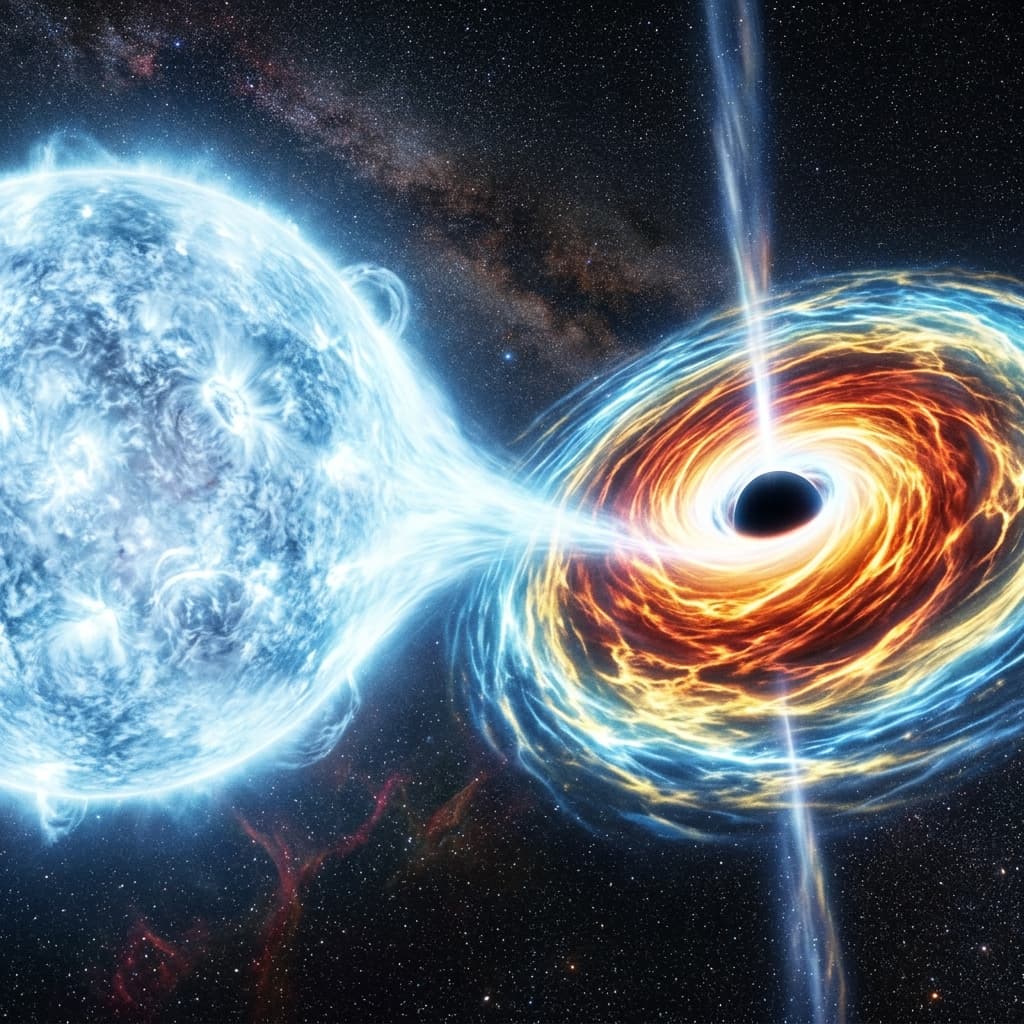
Gas approaching a black hole does not fall straight in — it has angular momentum, so it settles into a flattened, rapidly orbiting accretion disk. Friction and magnetic stresses within the disk heat it to millions of degrees, and it radiates ferociously across the spectrum. Magnetic fields threading the disk can also launch relativistic jets from the poles, firing material across hundreds of thousands of light-years.
When a supermassive black hole is feeding vigorously, the result is a quasar — quasi-stellar radio source, so named in the 1950s because the objects looked like points of light in optical telescopes while blazing in radio.
Quasars can outshine their entire host galaxy by a factor of thousands, from a region not much larger than our solar system. The efficiency is what makes this possible: accretion onto a black hole converts something on the order of 10% of infalling mass into energy, against roughly 0.7% for hydrogen fusion in a star. Gravity is a far better engine than nuclear fusion.
Because they are so bright, quasars are visible across nearly the whole observable universe, and they function as beacons for studying the early cosmos. Most are very distant, which means we see them as they were billions of years ago — quasar activity peaked early, when galaxies were gas-rich and their central black holes had plenty to eat.
Two pictures worth knowing
In 2019 the Event Horizon Telescope released the first image of a black hole: M87*, 6.5 billion solar masses, 55 million light-years away. In 2022 the same collaboration released Sagittarius A*, our own galaxy's central black hole.
Neither is a photograph in the ordinary sense. The EHT is a network of radio observatories spread across the planet, combined so that they function as a single telescope with an effective aperture the size of Earth. Petabytes of data were physically flown between sites on hard drives, because no network could carry the volume, and reconstructing the images took years.
What the images show is the dark shadow of the horizon against the glow of the accretion flow surrounding it. The bright ring's size and shape match general relativity's prediction closely — a theory published in 1915, tested a century later against a photograph of a hole in spacetime.
Hawking radiation
In 1974, Stephen Hawking showed that black holes are not entirely black. Quantum field effects near the horizon cause them to emit a faint thermal glow, and over unimaginable timescales they evaporate.
The rate is inversely related to mass, so bigger black holes are colder and last longer. A stellar-mass black hole has a temperature of roughly a hundred-billionth of a kelvin, far colder than the cosmic microwave background — meaning it currently absorbs more than it emits and is still growing. Only in the very distant future, once the universe has cooled further, will evaporation dominate. A solar-mass black hole would then take on the order of 10^67 years to disappear.
Hawking radiation has never been directly observed and probably cannot be with current means. It nonetheless sits at the centre of modern theoretical physics, because it creates the black hole information paradox: the radiation appears to carry no information about what fell in, which conflicts with the principle that quantum information cannot be destroyed. Resolving that tension is one of the main reasons black holes matter to physics — not as astronomical curiosities, but as the place where general relativity and quantum mechanics visibly fail to agree.
Sources and further reading
- Black Holes — NASA Science
- First image of Sagittarius A* — Event Horizon Telescope Collaboration
- Black holes and quasars — Chandra X-ray Observatory
- Hubble and quasar observations — ESA/Hubble