Spaghettification: What Happens If You Fall Into a Black Hole?
TL;DR Summary
It's a real scientific term, and it's as horrifying as it sounds. Explore the intense physics of falling past the event horizon.
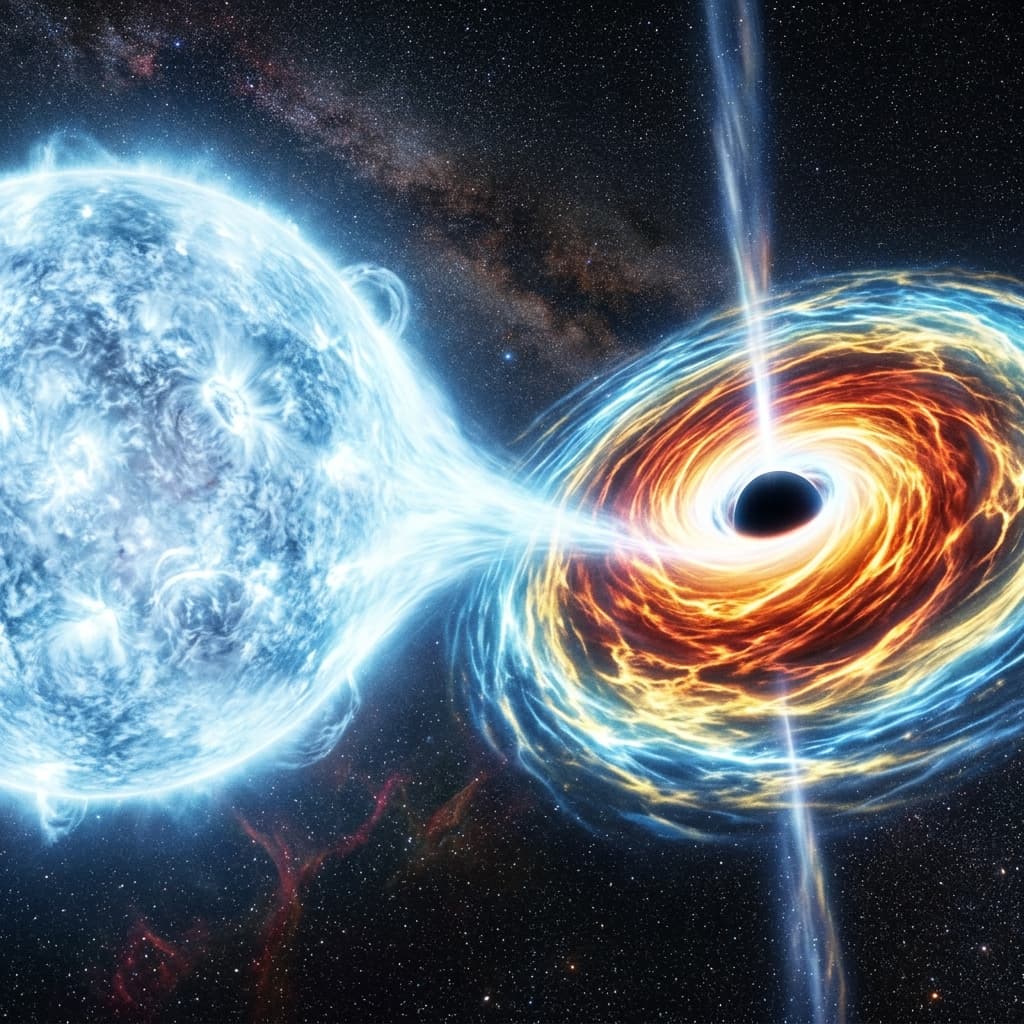
Black holes possess gravitational pulls so strong that nothing, not even light, can escape once it crosses the point of no return—the Event Horizon. But what would actually happen to your body if you fell into one?
Astrophysicists use a very specific, technical, and slightly comical term for this process: Spaghettification.
The Tidal Forces of Doom
Gravity decreases with distance. On Earth, the gravity pulling on your feet is technically slightly stronger than the gravity pulling on your head, but the difference is so microscopically small that you don't feel it.
Near a stellar-mass black hole, however, the gravitational gradient is incredibly steep. If you fell feet-first toward a black hole, the gravitational pull on your feet would be vastly stronger than the pull on your head.
This difference in gravitational pull is called a tidal force. As you get closer to the event horizon, the tidal forces would become so extreme that they would literally stretch your body vertically while simultaneously compressing it horizontally. You would be stretched out into a long, thin string of atoms—like a piece of spaghetti.
The Difference Between Small and Massive Black Holes
Counterintuitively, your experience depends entirely on the size of the black hole.
Stellar-Mass Black Holes: If you fall into a small black hole (like Cygnus X-1, which is about 21 times the mass of our Sun), the tidal forces are so intense that you would be spaghettified and torn apart thousands of kilometers before you even reached the event horizon. You would die instantly.
Supermassive Black Holes: If you fall into a supermassive black hole (like Sagittarius A*, which is millions of times the mass of the Sun), the event horizon is much larger, and the gravitational gradient is much gentler at the edge. You could easily pass through the event horizon without feeling a thing. Your body would remain completely intact.
However, once inside the event horizon, you are moving inevitably toward the Singularity—the infinitely dense point at the center. As you approach the singularity, the tidal forces will eventually catch up with you, and spaghettification is unavoidable.
Inside a black hole, space and time are fundamentally warped. According to relativity, all paths through space inside the event horizon point toward the future, and the singularity is your future. There is no turning back.